Thucydides was right: civilization is a thin veneer

C8403E5A-03D8-4A4B-9519-C14632AE13F5.jpeg

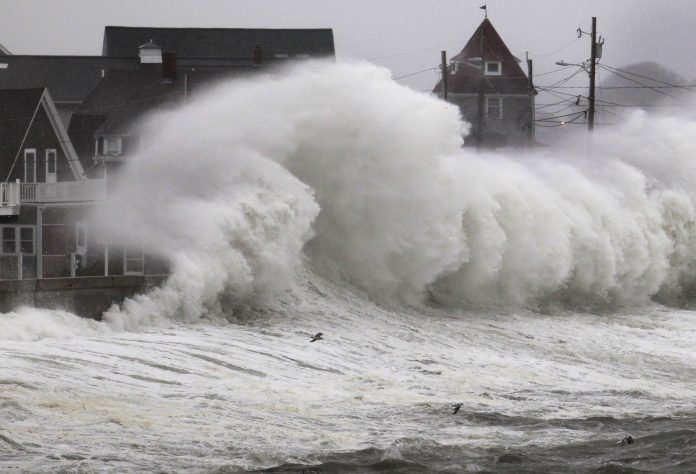
Natural disasters furnish a reminder of just how perceptive the Greek historian Thucydides was. A powerful nor’easter struck New England and much of the east coast today . . . and in effect temporarily returned those of us without electricity to tbe 19th century, huddling under blankets and reading by candlelight.

I am writing this by lantern light: tremble before my awesomeness!

Well, we do have Kindle. There’s that. Water is still hot though the heat is off. Nor are outside temperatures life-threatening. This isn’t the Blizzard of 2013, when eight-degree-Fahrenheit temperatures threatened life and limb. Still less is it some fearsome snowstorm on the prairie in days of yore, when little stood between settlers or Indians and the elements. But it is a far cry from blogging and watching Battlestar Galactica reruns this time yesterday.

We can at least conceive of what life without civilization and its conveniences would be like. It would be harsh.

Classical history makes this clear. Thucydides’ chronicle of fifth-century-BC Greece shows how natural and manmade catastrophes strip away normalcy, and do so all of a sudden. An earthquake fells the flower of Spartan military youth, and endangers the city’s survival. A plague of mysterious origin strikes Athens, laying a luminous civilization low overnight. Factional strife tears Corcyra apart, pitting citizen against citizen in a fight to the death to determine who will rule.

We commit a grave error if we think history with a capital H has exempted us from human travails of this sort. Being reminded of that almost makes you thankful for heavy weather and other misfortunes.

Almost.

Arm the first island chain

ASCMs

A hearty Huzzah! goes out to the Japan Ground Self-Defense Force for considering deploying truck-launched anti-ship missiles abreast of the narrow passages piercing the first island chain (click here), in particular Miyako Strait south of Okinawa. GSDF commanders have evidently been mulling such a course of action for years now.

Best I know, Toshi Yoshihara and I were the first to advocate an island-chain defense strategy in print, in the Naval Institute Proceedings back in 2012 (click here). Toshi and I urged the U.S. Army to wage “Asymmetric Warfare, American Style” in unison with our Asian allies. I returned to the topic in a solo effort in 2014 (click here), also in Proceedings, imploring the allies to “Defend the First Island Chain” and considering how to do so.

In that one I reviewed how armies have guarded walls and other defense perimeters in the past, and what guardians of a maritime defense perimeter might learn from their efforts. The Great Wall puts in an appearance, as does Hadrian’s Wall. So does a modern defense frontier, the French Army’s Morice Line in Algeria. The Morice Line was arguably the most successful defense line in history (click here). FLN militants broke an army against it.

A nautical Morice Line is something to strive toward.

In the interim we’ve been joined by the likes of Andrew Krepinevich in pushing the concept. That’s good company to keep. Andy expands the concept from the Ryukyus to encompass the entire first island chain, and styles it “archipelagic defense” (click here). The concept has found favor for good reason. Deployments on and around the islands broadcast a message to China: that two can play the anti-access game. If China’s People’s Liberation Army Navy wants to deter, encumber, or defeat American forces trying to enter or operate in the Western Pacific, occupants of the first island chain can replicate that strategy in miniature, and they can do so at modest cost to themselves.

And with better prospects of success than the PLA enjoys. Look at the nautical chart. To menace U.S. naval forces surging westward from North America or Hawaii, PLA weaponeers must monitor a vast volume of water and airspace, detect approaching foes, compute a firing solution, and put rounds on target with precision across vast distances. That constitutes a challenge of mammoth proportions. All American allies need to do is block a few straits that Chinese merchantmen, warships, and aircraft must transit to exit the China seas for commercial or military purposes.

The allies can turn terrain to advantage as they fashion anti-access forces. They hold what amount to fixed guard towers in a defense perimeter that meanders southward from Japan through Taiwan through the Philippine Islands and on to Indonesia. All they need to do is firm up the segments between the sentinel towers, a.k.a. islands, using manned or unmanned ships and submarines, aircraft ranging along the island chain, and, yes, missile-armed ground troops emplaced on the islands.

Being penned up within the island chain has been Chinese Communist Party leaders’ nightmare since the 1950s, when containment first became a thing. Let’s make their nightmare come true–and restore deterrence to the region.

It would have been malpractice not to design Japanese flattops for F-35s

DBFA293A-877B-48B9-BACF-A4F73F135CCA

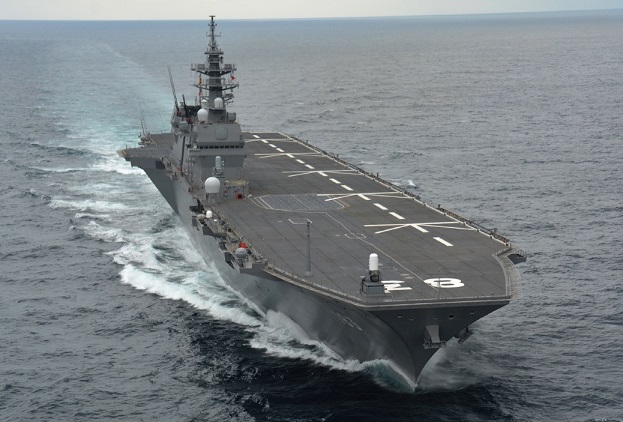
Over at The WarZone, an outlet you should visit regularly, Tyler Rogoway reports (click here) that Japanese officials now admit the Japan Maritime Self-Defense Force’s Izumo-class “helicopter destroyers” were designed so they could be converted to operate fixed-wing aircraft should political leaders ever give the word. Tyler takes a victory lap for foreseeing such a conversion.

I guess I can as well after holding forth on the topic at Foreign Policy (click here) some years back. Yes, DDHs are light aircraft carriers despite their branding as destroyers.

But puffery isn’t the important thing, fun though it is on occasion. A hardware point and a political point. The hardware point is that providing policymakers options is what military folk do. The JMSDF leadership would have been remiss not to have shipwrights construct helicopter carriers that could be repurposed for F-35B jump jets at some future date. Why be inflexible in naval architecture?

The political point is that Tokyo dissembled about Izumo’s design when the vessel entered service, and everyone knew the leadership was dissembling. That unforced error handed China’s leadership a talking point about Japanese duplicity and latent aggression, and thus reinforced its diplomatic narrative.

Candor is a virtue even with—especially with—prospective foes. When Teddy Roosevelt advised statesmen to speak softly, he meant for them to refrain from bluster. He wasn’t counseling them to obfuscate or deceive.

Indeed.

Reorienting naval aviation demands a cultural revolution

C14906A6-ECA7-411A-B1AD-9D83594ECAFF

So Vice Admiral DeWolfe Miller, the U.S. Navy’s new naval aviation boss, wants to make combat readiness vis-à-vis peer antagonists the aviation community’s central purpose after sixteen years of rendering close air support in theaters like Afghanistan, Iraq, and Syria.

Good. As poet William Wordsworth might say: bliss it is in this dawn to be alive!

Now comes the cultural revolution, or rather counterrevolution. Sixteen years of bombarding ground targets rather than girding to fight enemy air fleets may have altered the culture of naval aviation. The shade of Julian Corbett might point out that exercising command of the common—including the aerial sector thereof—demands different tactics, skills, and even hardware than does battling for command.

And projecting power is what carrier pilots have been doing—many of them for their entire careers, sixteen years into the post-9/11 war on terror.

But when an enemy air force mounts a challenge to American air superiority and supremacy, the fight for command has to come first—and take precedence. Reinstating habits of mind and action that served naval air well during the Cold War and World War II before it should indeed rank atop Admiral Miller’s list of priorities.

Trouble is, institutional cultures don’t change overnight just because someone wearing stars decrees it shall be so.

Ask submariners. The silent service spent the 1920s and 1930s inculcating doctrine for assailing enemy battle fleets. So singleminded were top commanders that methods for raiding merchant shipping languished. In fact, the U.S. Pacific Fleet submarine command had to weed out skippers who couldn’t make the leap from the one to the other mode of operations after the attack on Pearl Harbor.

And submariners then had it easy compared to aviators today. Pivoting from attacking men-of-war to attacking unarmed or lightly armed merchantmen is easier than switching from low-intensity combat to high-intensity warfare in the wild blue.

December 7 is when Chief of Naval Operations Harold Stark issued the order for submariners to sink anything flying a Japanese flag—including, and especially, merchantmen. SUBPAC gave captains two patrols to produce results against Japanese shipping. They were gone if they failed to produce the goods. Youth unencumbered by prewar ways of doing things took their places, and prosecuted the campaign with ruthless efficiency.

Extreme cultural change may demand extreme measures. The air boss may soon find that out.

Has China passed an inflection point?

inflection pt

Gordon Chang maintains (click here) that “China has passed an inflection point” in its ascent to world power, and that bad things are in the offing. I tend to agree . . . although as the great Yogi Berra counsels, making predictions is tough—especially about the future.

Some years back some friends and I—including the aforementioned Mr. Chang—put together a volume (click here) exploring how population decline shapes great-power politics and strategy. The outlook for China was grim at best. Beijing may have relaxed its one-child policy, for instance, but it will have to live with the social and cultural wreckage—not just declining population numbers but the destruction of China’s traditional family system—for decades to come. Gordon projects economic figures that likewise portend ill for China’s world-power standing.

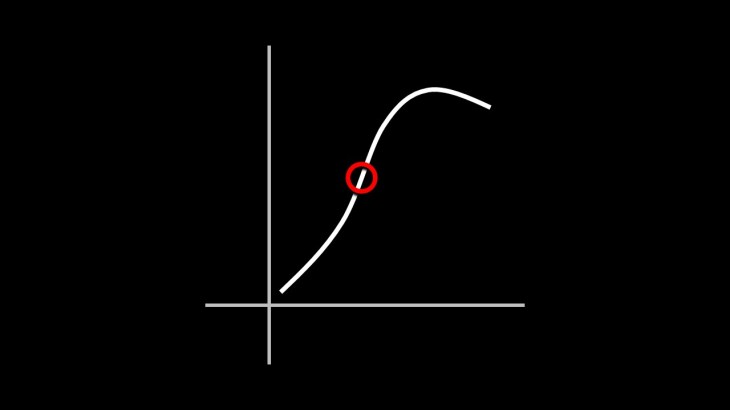
Now, it appears Gordon, unlike many commentators, deploys the mathematical phrase inflection point with precision. He’s not saying China is in freefall, or even that its rise has already come to a halt. He is saying its rise is slowing and could come to a halt—or even go into reverse.

Denizens of wonkdom oftentimes use the phrase interchangeably with maximum or minimum, or sometimes just as shorthand for some significant change of state. It offers a fancy way to indicate that something or some trend has peaked or cratered. What an inflection point really marks, though, is a change in the rate of change from acceleration to deceleration or vice versa. The gradient flips from positive to negative or the reverse—akin to applying the brakes or the accelerator in the automotive context.

So a curve that’s on the rise will keep rising for a time after it passes the inflection point, but its rate of ascent will slow until it reaches zero at the curve’s maximum point. At that point it may plateau, or it could go into decline. It could even resume its upward trajectory if it passes another inflection point. The converse is true of a descending curve or trend. Its descent will slow until it flatlines, bounces back, or reverts to freefall.

Transposing the concept from a math textbook to East Asia, China could still be growing by economic and military measures, and amassing new diplomatic clout to go with its physical power. But at the same time its rate of growth could be decelerating—perhaps to zero. China’s rise could top out or even slip into decline. It would take some serious wisdom and resolve on the part of the Chinese Communist Party leadership to restart the uptrend.

We shouldn’t take too much comfort, though, if China is indeed bumping up against its limits. You might suppose a state undergoing demographic or economic decline would conduct its affairs with caution in order to husband increasingly scarce resources. And you would be right: that does make sense. But my finding from the population-decline study—drawing on demographic catastrophes in classical Greece—was that demographic stresses may have just the opposite effect. A contender could run even more risks than it normally would despite its loss of manpower and other resources.

Far from trying to conserve scarce resources, Athenians—always a venturesome folk—courted greater and greater dangers in their war against Sparta after suffering a plague that claimed the lives of some thirty percent of the populace. That seems perverse—but if it happened before it could happen again. China might embark on an Athenian future, accepting new risks if the leadership believed troubles at home were about to cap its ambitions abroad. Internal woes could give rise to foreign-policy adventurism on a scale hitherto unseen, if China’s rise has gone past an inflection point.

A turbulent ride could await Asia.


Learn from trauma

USNI News reports (click here) that my one-time professional home, the Surface Warfare Officers School in Newport, has created a simulation of last year’s USS Fitzgerald collision as a training aid for students. Students have the maneuvering data for Fitzgerald–position, course, speed, and so forth–as well as the relative positions, course, and speed data for contacts within the destroyer’s sensor range. Most strikingly, they also have audio recordings from the ship’s watch team, documenting in excruciating detail the sequence of events leading up to Fitzgerald‘s collision.

It must be a harrowing experience to relive what was by no means an unavoidable mishap.

The surface and submarine communities have a macabre advantage when disaster strikes. Disasters involving ships are big and traumatic, and they involve lots of mariners. Cataclysm concentrates minds. Airplane crashes tend to happen out of view and to involve small numbers of crewmen. Unless there’s a spate of accidents, or unless an individual accident is especially newsworthy–say, if the U.S. Navy Blue Angels lose a plane and aviator at an airshow–aviation disasters stay mainly out of public view. Naval aviation may not learn as much because the community is spared the public and congressional outcry.

In a very real sense, then, disaster confers opportunity. It compels us to amend how we think about our profession. It collapses resistance to necessary change. And, as the Fitzgerald simulation doubtless will, it makes an impression on veteran seafarers and newcomers to the profession. We collectively resolve to do better.

When I taught firefighting and damage control at SWOS, accordingly, we would open the first day of the course with a series of film clips from recent-ish naval disasters involving fire, flooding, exploding ordnance, or all of the above. We led off with the Forrestal fire (1967), moved on to the Exocet missile strikes on HMS Sheffield (1982) and USS Stark (1987), and finished with the mine hits on USS Samuel B. Roberts (1988), Princeton (1991), and Tripoli (also 1991). The “main-space fire” on board USS White Plains (1989) was also much on our minds in those days. Combine a leaking fuel pipe with hot machinery in the engineering plant and you have the potential for an inferno that devours sailors and materiel–as indeed befell White Plains.

In Common Sense Thomas Paine observed that crises have their uses. Indeed they do, and the surface-warfare community is wise to make use of its recent crises to revise its institutional practices and culture. Let’s shift our paradigm–and replace it with something healthier.

Professional IR schools aren’t the only ones that scant history and strategy

0707-32_Page_2_Image_0001

A quick follow-up to my last post: yesterday I was up to Tufts to talk maritime strategy with some undergraduates, and camped out in the hallowed Hall of Flags at the Fletcher School for an hour beforehand. While sojourning on memory lane it occurred to me that Professor Steve Walt’s item at Foreign Policy implies that professional international-relations schools are the only IR institutes out of touch with history and strategy. Far from it. At least the professional schools are interested in real-world diplomacy and strategy. Educating current and would-be practitioners is why they were founded and what they do.

That practical bent is their North Star. They can recover their historical sensibility because it has practical uses for statesmen and commanders. I see hope.

Traditional university IR departments are different creatures. I came to Newport from such a department eleven years ago. If the professional schools are indifferent to IR theory and its uses as an analytical tool, by and large university departments obsess over theory to the exclusion of all else–including reality as chronicled by historians. None other than Steve Walt diagnosed IR departments’ failings back in 1999, in a cheeky International Security article titled “Rigor or Rigor Mortis?” (click here). Walt explores the mania for “rational choice” in academic international relations, which–to oversimplify–holds that decision-makers are rational actors who apply cost-benefit analysis dispassionately to the practice of international affairs. Tote up the costs of some course of action, estimate the benefits, and proceed if the benefits justify the costs.

To the claims that rational-choice theory is rigorous, and that rigor is everything in IR research, Walt ultimately says meh.

And rightly so. Rationality is an ideal to strive toward, not an established fact. Historians and philosophers from Thucydides onward note how passions deflect human beings from purely rational choice. To compound the problem, international-affairs practitioners operate in a competitive environment that tends to inflame passions–driving interactions among competitors even further from the rational ideal. Far truer to life than rational choice is strategist Edward Luttwak’s idea that ordinary cost-benefit logic may prevail–more or less–in peacetime interactions, but that a “paradoxical logic” takes over in power politics and, still more, in armed conflict.

“Ironic reversals” of fortune are commonplace as each competitor tries to outdo the other. It takes farsightedness and heroic willpower to impose rationality on such a hothouse environment, yet that’s what Luttwak, Clausewitz, and other masters of strategy demand we attempt to do. The basic assumption that strategic competition doesn’t lend itself to rational choice constitutes a firmer basis for strategic thought than does rational-choice theory. In short, rational choice is an assumption that shouldn’t be. It can be put to the test of historical evidence–and that test makes short work of it.

But history–in particular diplomatic and military history–is in disfavor on most campuses nowadays. It’s easy for IR students and faculty to lose their moorings without that reality check. Compounding the problem is IR departments’ obsession with reducing complex human interactions to numbers that can be graphed in hopes of revealing laws governing these interactions. Harvard IR professor Stanley Hoffmann was one of the greats in the field and a qualitative, not quantitative scholar. Late in life Hoffman quipped that neither he nor the likes of Samuel Huntington, the author of The Clash of Civilizations and another of the greats, “would get tenure under the current conditions”–under the tyranny of mathematics, in other words.

Professional IR schools stand some chance of escaping that tyranny. They not only cater to students who want to be or already are practitioners, they commonly hire former government officials, ambassadors, or military officers to the faculty. Admiral Jim Stavridis is dean of the Fletcher School, for example. Bringing folk into the mix whose inclination is to ask so what? when faced with abstract theory or statistics lends ballast to research and teaching at professional IR schools. Faculty want to help the next generation perform better than they did. Students of practical leanings undertake academic study to upgrade their professional competence. Both constituencies regard formulating theories, describing events with statistics, or fitting data points to graphs as a subsidiary function.

Bottom line, whatever the professional IR schools’ travails, they will find it easier to self-correct than will university departments. Healthy debate is what importing a mix of backgrounds and outlooks into the faculty and student body provides.

Give me professional education any day.

Learn history to cultivate a tragic sensibility

fletcher_photo_Responsive

Over at Foreign Policy on Tuesday, Harvard professor Steve Walt held forth (click here) on the ills besetting professional international-relations schools. Check it out. Nor is this a new theme for Professor Walt: he wrote a mostly approving after-action report (click here) about elder statesman Henry Kissinger’s visit to Harvard six years ago, when Kissinger said much the same thing. It’s worth remembering that Kissinger cut his teeth many decades ago researching the Congress of Vienna, the gathering that fashioned a lasting peace following the defeat of Napoleon. What he knows about diplomacy and martial affairs, he inferred from history.

Chief among the IR schools’ failings, writes Professor Walt, is their indifference to history, IR theory, and strategy. What he says saddens the heart of this two-time graduate of a professional IR school, mainly because it rings true. (It gladdens the heart of this teacher in a department whose strategy courses rest on the bedrock of history and theory.) It feels as though schools demand less and less in these areas. Without that demand signal, students tend toward courses that are mainly about the processes of international negotiations, institutions, economics, and so forth. In other words, about abstractions.

My fifteenth and twentieth class reunions at the Fletcher School are drawing nigh, but even in yesteryear some of my classes seemed estranged from the lives of real human beings–present or past. At times, in fact, I felt like I was back in grade-school civics class, studying how a bill becomes a law under the U.S. Constitution. As though that simple algorithm encompassed the whole of politics. Which it does . . . if you ignore political parties, special interests, ethnic and religious groups, sectional interests, and on and on. Anyone who thinks that algorithm describes how a bill becomes a law should review how Congress and the Obama administration came to “sequester” domestic and defense spending, with baneful effects that ripple through the armed forces and many other sectors to this day.

Process tells us little about real life.

IR schools’ habit of discounting the human factor in politics, reducing complex events to numbers we can graph, and emphasizing bureaucratic flow charts exacerbates a self-defeating trait in American society: we wake up every morning and see a world made new. As Henry Ford once quipped, history is more or less bunk to Americans. That’s history means something is past, with no relevance or value for us today. For us history begins today–every day!

Except it doesn’t. It’s good not to be a slave to past misdeeds or enmities, but our forbears handed down much of value to us. Their achievements should inspire us, while their faults and frailties warn posterity that there are things never to repeat. Forgetfulness is not a virtue.

Now, I find little to quarrel with in Professor Walt’s diagnosis, but I would put the accent elsewhere. Even he seems to regard history as a mechanism. It’s an expedient that helps us understand that people from other countries, regions, and traditions see the world differently, and to factor that in when trying to persuade them to do what we deem worth doing. There’s no gainsaying that. We need not have sympathy with foes, or even see the world precisely as allies and friends do; empathy with how others see and interpret the world is a must.

But empathy is not enough. I would go beyond Walt’s pragmatic view of history’s value. Studying history instills a tragic sense about human affairs while reminding us how little is new under the sun.

Statesmen and military folk possessed of that tragic sensibility will know and grok going into some competitive venture that powerful motives drive antagonists to thwart our will, that antagonists are resourceful and have ingenuity of their own, and thus that we’re unlikely to get our way in full. Fortune is fickle, there are limits on our ability to gather, process, and distribute information, and deploying gee-whiz armaments or sensors is no guarantor of strategic or political success in any event. Heck, no one has even managed to repeal Murphy’s Law–or is likely to.

One hopes professional IR schools will get back to their roots in history, theory, and philosophy–and regain the sense that there are stubborn limits and barriers to our aspirations. That’s a sensibility worth passing on to the next generation of our diplomatic and military corps.

Statement game in the Black Sea

Operation Atlantic Resolve / Exercise Sea Breeze 2014

USNI News and other news outlets carried the story (click here) that the U.S. Navy now has two guided-missile destroyers, USS Ross and USS Carney, cruising the Black Sea. Why the departure from recent operational patterns?

Clausewitz defined war as a trial of moral and physical forces, chiefly through the medium of physical force. Peacetime tests of strength such as in the Black Sea or South China Sea are trials of moral and physical forces, chiefly through the medium of perceived physical force. Our navy, acting on behalf of the Trump administration, is announcing that Washington will not be cowed into surrendering what geopolitics specialist Nicholas Spykman termed the “marginal seas” around the Eurasian periphery. Command of those seas was critical for the Royal Navy during Britain’s imperial heyday, and it’s critical for the United States and its allies today.

So the U.S. Navy is making a statement to Moscow about American resolve by doubling its destroyer presence in the Black Sea, and it’s making a statement to allies and friends in the marginal seas that America will be there when the chips are down.

suspect the navy is also making a statement about its own ability to do its job after the annus horribilis that was 2017 for the surface navy. Yes, we have work to do . . . but we have no intention of withdrawing to homeport or ceding control of important expanses to predatory powers while we get the fundamentals right again.

Think of this as a dialogue between armed services—a process of challenge and reply—and you’ve got the idea.

Credit where credit is due

9DC2805F-4F1C-4761-B804-746C3AADF45A

Epoch Times carried a story (click here) this weekend about last week’s flurry of China-related congressional hearings, including the Thursday U.S.-China Economic and Security Review Commission panel on which I was honored to serve. Exposure is always welcome, but I do have to give credit where credit is due: the reporter quoted me as saying China will have the world’s largest navy by 2020, measured by raw numbers of combatant hulls. And so it will, and indeed I did say that.

But I was quoting from the estimable Rear Admiral Mike McDevitt of the Center for Naval Analyses—as is clearly annotated in the text and footnotes. (I double-checked.) During the Q&A one of the commissioners also ascribed the quotation to me, and I made sure the credit went to Mike then as well.

Two quick points. One, it is amazing how often this sort of thing happens: people latch onto some slogan or catchphrase, develop lockjaw, and drag it around. It’s similar to editors’ eternally reaching for the headline that will lodge in folks’ brains and bestow lasting impact on the article. Washingtonians appear peculiarly prone to sloganeering, which is why cutesy phrases—”frenemies,” “sharp [soft, sticky, smart] power,” “Thucydides trap,” and on and on—sluice through political and foreign-policy commentary.

And two, making Mike’s quotation the banner for my remarks undersells my views of the scope of the China challenge. I put the thesis to the USCC that a fraction of the U.S. Navy will face off against the whole of the PLA Navy backed by PLA Air Force warplanes and the PLA Rocket Force, on China’s ground and far from American ground. The PLA Navy, then, is only part of the much bigger problem of joint Chinese sea power. We had better ensure we retain a heckuva advantage in material quality and combat prowess to offset increasingly forbidding strategic circumstances.

Do we still command such an advantage, and if not, how do we get our mojo back?