What if they built a battleship that couldn’t duel other ships?

7756146C-B8A7-4D1D-A7A8-0DD6E8711D09

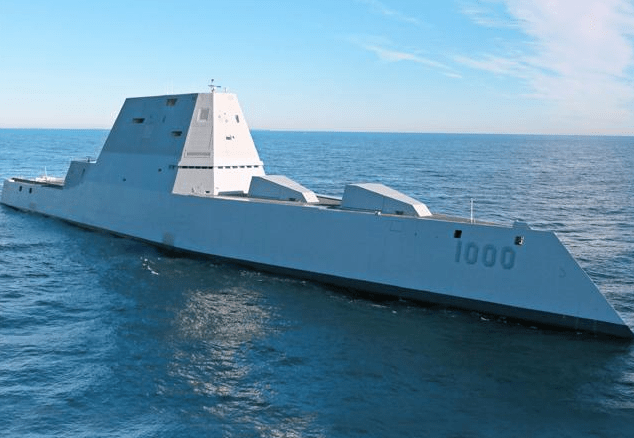
What if indeed? But in effect that’s what U.S. Navy fleet designers ordered done when they conceived of the DDG-1000 Zumwalt-class destroyers earlier this century. The Zumwalts are outfitted with an advanced gun system capable of lofting precision-guided projectiles far inland from the sea . . . but not assailing enemy men-of-war. (That leaves aside the fact that the gun rounds were so expensive the navy canceled them, even for land attack. Click here for that sad saga. A gun without ammunition is, well, dead weight.)

Wow.

I remember being gobsmacked a few years back at learning how one-dimensional Zumwalt was. Why design a ship around a gun that’s not multipurpose? It defies common sense. The DDG-1000’s travails must be another hangover from the immediate post-Cold War years, when naval leaders told one another—and told all of us dissolute youths who knew no better—that naval history had ended (click here) with the Soviet Navy’s downfall.

With no one left to fight at sea, the leadership reasoned, there was little reason to go to the trouble and expense of equipping surface ships for major fleet engagements.

That brand of Year Zero thinking (click here) would have met with incredulity three-quarters of a century ago. During World War II battleships morphed readily into shore-bombardment platforms once it became clear that aircraft carriers were now the U.S. Navy’s heaviest hammer. Had battlewagons’ armament been designed solely for fleet-on-fleet combat, marines and soldiers would have gone without high-volume, all-weather fire support when assaulting Pacific atolls or Atlantic beaches. Naval gunfire was on hand precisely because naval weapons were multipurpose.

Now, thankfully, Defense News reports (click here) that the Trump administration has undergone a change of heart and requested a modest sum to convert the DDG-1000s to fight rival surface fleets—and fix that mistake. Zumwalts boast a humbler missile magazine than do Aegis cruisers or destroyers, but their missile silos could be stuffed with SM-6 interceptors repurposed for anti-ship missions, along with Tomahawk missiles capable of striking ships at sea. The Tomahawk was a multipurpose weapon at one time, but was reduced to—you guessed it—the single function of land attack back in the 1990s. Narrowing our portfolio was an industry unto itself once upon a time.

Combined with the Zumwalts’ stealth, such an arsenal could make a difference in open-ocean combat. One could see the DDG-1000 as a latter-day surface raider, sniping away at enemy formations on the high seas.

The lesson from Zumwalt? Keeping your portfolio diverse is a blessing in battle, when your world is apt to change around you—or, more accurately, when your foe changes it around you, as he has every incentive to do. Equipment should be as versatile as possible. The Swiss army knife should be fleet architects’ ideal—not some artisanal machine tool that does one job exceptionally well but can’t adapt easily to new functions.

From now on let’s take a workmanlike approach to building our naval armory.
Navies aren’t businesses—and can’t operate by business principles

The redoubtable Sydney Freedberg reports (click here) on some very promising utterances out of the U.S. Navy leadership regarding whether the sea service can operate according to precepts devised to make business firms more efficient. I commented on this over at The National Interest a couple of years back (click here).

Short answer: no.

Thankfully, navy kahunas have come to agree. As they should. Take “just-in-time” manufacturing, which has been all the rage since Japanese firms pioneered it during the 1970s (click here). To oversimplify, that’s the notion that a business reaches maximum efficiency when it keeps few if any spare parts and supplies on hand, and depends on the supply chain to deliver just the right things on demand.

Makes sense, doesn’t it? Why invest in excess capacity?

And indeed it does make sense provided the assembly line runs smoothly and provided the supply chain performs as expected. But that’s not reality for armed forces. Edward Luttwak points out that warlike endeavors unfold according to a “paradoxical logic” that—one hopes—a manufacturer like Toyota will never encounter. Toyota runs by peacetime cost/benefit logic, and just-in-time techniques suit predictable, non-threatening operating conditions.

Now superimpose wartime surroundings on our hypothetical Toyota production line. Suppose saboteurs from Honda are constantly trying to interrupt the supply chain, starving Toyota of materiel to damage its competitive standing and grab market share for Honda. That’s what martial competition is like: antagonists trying to outdo each other by fair means or foul. No regulator will step in.

Still think Toyota would embrace just-in-time production? Nope. Prudent managers—those who cared about staying in business—would stockpile the makings of cars lest the infernal Honda sever the supply chain. They would regard a surplus as—with luck—suffiicient, and just enough as a likely deficit that could work disaster. Toyota would do the same to its competitors—and back and forth the competition would go by Luttwak’s paradoxical logic.

One hopes the navy leadership, the Pentagon, and the Trump administration as a whole now grasp that, as Big Bird used to sing, one of these things is not like the other. Military services are not businesses—and import the latest management theories from the business world at their peril.

That’s a supply chain to beware of.

Everything that floats—and some things that don’t—is part of Chinese sea power

15BF693D-09C5-4F62-BA80-F66A98C04A6F

Opening remarks to congressionally chartered U.S.-China Economic and Security Review Commission, Washington, DC, February 15, 2018:

Ladies and gentlemen of the Commission, I would like to leave you with a few big points regarding Chinese sea power and maritime strategy.

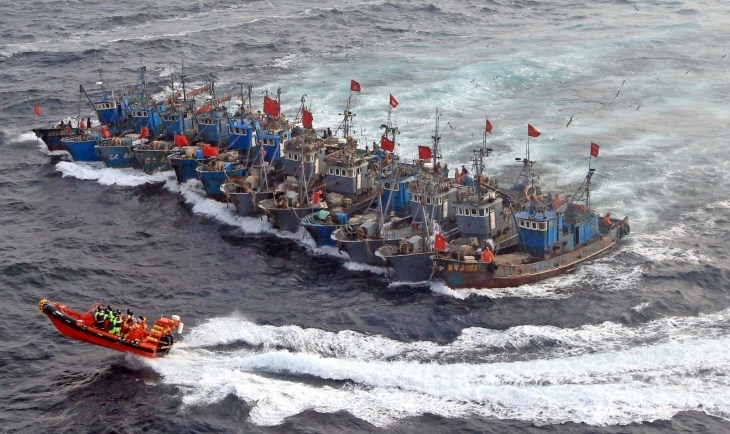
1. First of all, China operates a true national fleet. It is a composite of naval and non-naval, government and non-government shipping, including everything from aircraft carriers at the high end to coast-guard cutters for defending maritime sovereignty to fishing boats crewed by militiamen at the low end. China thus takes a genuinely maritime outlook on the sea. Anything that floats is probably an implement of sea power for Chinese leaders. This is an all-encompassing vision and a broader view than our own, which sees the U.S. Navy, Marine Corps, and Coast Guard—the naval services—as the components of our national fleet. This difference in perspectives creates asymmetries and thus problems for American seafarers. How should, say, a destroyer skipper respond if China Coast Guard cutters or fishing vessels interfere with freedom of the sea in the South or East China Sea?

2. Sea power isn’t just about shipping for China. Sea power for China includes not just ships of many types but shore-based firepower, including anti-ship cruise and ballistic missiles and missile-armed combat aircraft. So China’s competitors will square off not just against its national fleet but against the PLA Air Force and Strategic Rocket Force. What that means for us is that our Pacific Fleet—a fraction of our navy—will potentially confront the whole of the PLA Navy backed by the PLA Air Force and Rocket Force, on China’s home ground and far from seats of American power. This is a difficult operational and strategic problem to say the least.

3. What does China want out of sea power? It wants access. It covets commercial, political, and military access to theaters the leadership deems important, such as the Indian Ocean. But access starts at home for China. Among the great powers it is uniquely encumbered by strategic geography, manifest in the offshore island chains. Chinese strategists liken the first island chain to a “metal chain” the United States and its allies have hoisted across Chinese access to the Western Pacific and Indian Ocean—barricading Chinese shipping and aircraft within. In order to assure reliable access to waters beyond the first island chain, China’s PLA has fielded a modern surface fleet, an array of submarines and light surface craft suitable for offshore picket duty, and, as mentioned, a family of land-based aircraft and missiles able to strike out to sea.

The basic idea is to isolate U.S. and allied forces already present in the Western Pacific from U.S. Pacific Fleet reinforcements coming from Hawaii or the West Coast. Having done that, PLA defenders will inflict heavy losses on each force separately. If the likely costs and dangers of sending reinforcements to the Western Pacific exceed what Washington expects to gain, then U.S. leaders may desist from trying. They may decline to pay that price. At a minimum they may hesitate while deliberating—and thus grant China time to accomplish its own goals in the region. This is what we mean by “anti-access” and “area denial,” and what Chinese officials and strategists refer to as “active defense” or, in recent parlance, “offshore waters defense.”

Continue reading →

False consciousness about maritime security: it’s not just a European thing

BA517E39-4D8B-4CB1-AC4B-B8559EFBD670

Surveying the maritime security setting reveals some glaring anomalies. To name one: Europeans fret constantly about Russian mischief-making at their door, yet they constantly build down the military and naval forces needed to deter or defeat aggression. Great Britain’s Royal Navy is now smaller than the French Navy for the first time since the day of Nelson and Napoleon, and appears poised to disband its amphibious fleet. The NATO secretary general boasts that (barely) over half of Alliance members will meet the exceedingly humble minimum standard of spending 2 percent of GDP on defense. They will do so by . . . 2024.

That underwhelms. It also defies predictions that grave threats draw forth serious replies from those threatened. One doubts President Putin spends much time cowering before the European juggernaut.

Scrimping on self-defense is not a new phenomenon on the Continent. Back in 2002 analyst Robert Kagan published a small book that always struck me as having a large truth quotient. In Of Power and Paradise Kagan contends, in brief, that Americans are from Mars while Europeans are from Venus. Having provided for military security in what Nicholas Spykman called the “rimlands” of Western Europe and East Asia for many decades, Americans see force as a natural implement of statecraft. Having sheltered underneath U.S.-furnished security for all those decades, Europeans have come to believe military defense is something others do.

The enlightened trust to peaceful negotiations and international law and institutions—and, from time to time, rebuke their defenders for their retrograde ways. Continue reading →

South American sea power: think globally, act locally

Chilean_Navy_frigate_CS_Almirante_Riveros_(FF_18)_steams_past_Hickam_Air_Force_Base

Inquires a Chilean friend, “what is the utility of navies such as the Chilean one? Should it partner with the U.S. Navy if Chile’s main trading partner is China?” From a neophyte on the subject of South American sea power: no and yes.

No, Chile needn’t join any sort of formal maritime alliance with the United States. As Yale geopolitics guru Nicholas Spykman might say, look at the map. It’s hard to stage operations in Asia across the vast emptiness of the Pacific Ocean. We make much of the geographic distance separating the fleet base at Pearl Harbor from East Asia, but the North American west coast is more than two thousand miles farther away than Oahu from potential Asian battlegrounds. Operating in Asia is no simple feat — even for the U.S. Navy, with all its geographic and resource advantages.

Spykman might put it thus: the southern continent might be called South America, but it could just as well be dubbed East America. The vast majority of it lies east of Washington, DC. Santiago, the Chilean capital, lies slightly east of Boston, Massachusetts. It also lies far to the south, at the terminus of a distended great-circle route to Northeast Asia. Bottom line, it’s over 10,000 miles from Chilean seaports to Tokyo Bay. That’s close to double the steaming distance from San Diego to Tokyo Bay, which comes to just under 5,600 miles.

That being the case, it would be a bridge too far for the Chilean Navy to join a maritime coalition in Asia under U.S. auspices. The practical difficulties are forbidding. Consequently, there’s little reason for Chilean leaders to antagonize the Colossus of the Far East barring some truly extraordinary circumstances. All governments, including Santiago, must put the national interest first. That includes economic interests, and in turn the well-being of the populace.

If China is Chile’s prime trading partner, Chilean leaders have reason to be circumspect — declining to take on needless quarrels. That’s how I would play it.

But Yes, the Chilean Navy can and should act as a silent partner in U.S. maritime strategy. The 2007 and 2015 editions of the U.S. Cooperative Strategy for 21st Century Seapower make it plain that preserving freedom of the sea is central to American strategy, and that alliances, coalitions, and partnerships of all types are the way to amass enough forces at enough places on the map to make that happen. Washington has in mind a kind of joint custodianship of the liberal system of seagoing trade and commerce.

Chile can play its part in that multinational strategy by keeping good order at sea in its own offshore waters, and by making common cause with fellow South American fleets. No one need come to its assistance. Santiago can help the United States and its partners by helping itself. And it can do so without concluding an alliance that affronts China.

Chileans can have it both ways — for the time being.


Our navy deliberately forgot how to fight

from the sea

Captain Pete Pagano, my old Strategy & Policy classmate from — gulp — 1992-1993, has a nifty piece over at the Naval Institute Proceedings this month wondering, “Have We Forgotten How to Fight?” Not quite. It’s actually worse than Pete lets on. Back in 1992 the U.S. Navy and Marine Corps leadership instructed the sea services to forget how to fight — or at least how to fight serious rivals on the order of the Soviet Navy or Imperial Japanese Navy.

Pete and I were lieutenants in 1992, when sea-service chieftains issued . . . From the Sea, their first strategic concept for the post-Cold War era. That directive was a real head-scratcher for us. The preamble to . . . From the Sea stated that with the fall of the Soviet Union, “the free nations of the world claim preeminent control of the seas.” With no one left to fight, the document’s framers maintained, “our national maritime policies can afford to deemphasize efforts in some naval warfare areas.” Indeed, the services “must structure a fundamentally different naval force,” undertaking “a fundamental shift away from open-ocean warfighting on the sea toward joint operations conducted from the sea.”

That’s a heckuva lot of fundamental change. In effect the service chiefs declared that maritime history had ended, much as Francis Fukuyama declared that same year that political history had ended with the Cold War. The U.S. Navy would never again have to fight for command of the sea, so it had little need to prepare for major combat. It could treat the seas as an offshore preserve from which to project power onto foreign shores. Small wonder the fleet deemphasized efforts in such disciplines as anti-submarine warfare and surface warfare.

The leadership decreed it should be so — and so it was.

In other words, the navy relegated these warfare domains to afterthought status, and is now struggling to catch up as China rises to great maritime power and Russia relishes its troublemaker role on the high seas. History does not like to be mocked. Let us resolve never again to proclaim that the demise of a peer force has repealed basic naval functions, and that we can use the sea with impunity. You do not regenerate hardware, doctrine, and habits of mind for such difficult arts as ASW and SUW overnight. They have to be in place at the onset of competition with some new antagonist.

History may take a holiday, as it did for a few years after the Cold War. But it never ends. If we have the good fortune to prevail in our strategic competition with China and Russia, let’s husband our combat excellence in the expectation that new challengers will come along sooner or later.

As they will.

China’s soft power got punked in Pyeongchang

2B75E64B-F4A6-4E6C-BFD5-7A800342A4EB

Congratulations to our South Korean friends for putting on a dazzling and oh-so-creative opening ceremony for the 2018 Winter Olympics last Friday. If any benighted soul still harbored doubts as to which Korea stands at the civilized world’s forefront, Pyeongchang entombed those doubts.

In fact, congratulations for one-upping not just North Korea but a certain giant country that lies to Korea’s north across the Yalu River — a country that, once upon a time, sought to project the image of a nation that was not just venerable but beneficent. That country hosted the Olympics a decade ago in a capital city that rhymes with aging.

The 2008 Olympics constituted part of a charm offensive that country was carrying on to burnish its soft power — in other words, to cast itself as a responsible great Asian power that no one need fear. Alas, those days are long gone. It was all a sham. That country junked its soft-power offensive years ago, turning to intimidation and coercion.

Better to overawe than comfort and conciliate smaller neighbors, it seems.

Pyeongchang reminds us what soft power is truly about. It’s about the power to attract, not the power to bully. It’s about having an attractive culture and society and living by one’s principles rather than putting everyone on about one’s intentions. South Korea has outdone China that northern country despite the mismatch in size and resources.

Huzzah!

Warrior spouses

zombie

Last Tuesday evening some 125 Naval War College spouses descended on Spruance Auditorium to hear yours truly hold forth on “Maritime Strategy and Zombies” — a zombie being some fallacy about sea power that you gun down with a shot to the head, only to see ten more just like it come back at you. Such deathless fallacies include the ideas that the nation that spends the most on its navy wins, that the U.S. Navy is smaller than it has been since 1917 or so large it’s unbeatable, and on and on.

Each of these ideas contains part of the truth—budgets, tonnage, and numbers of hulls do matter—but commentators tend to draw sweeping conclusions from the fact that America outspends its competitors and constructs larger warships. That the U.S. Navy has to steam across thousands of miles of empty ocean just to get into the combat theater translates into advantage for a China or Russia—even if their navies remain weaker than ours on the whole. This is lost on many commentators, even the greats in the field.

Here’s the reality: if we get in a Western Pacific scrap with China, a fraction of our navy will face off against the whole of China’s navy backed by China’s air force and strategic rocket force. As a military we’re far away and spread out across the globe while our potential foes bestride home ground and can concentrate all their military might on potential battlegrounds. Who wins in those circumstances? The outcome is anything but foreordained. To think otherwise amounts to hubris.

To all appearances the attendees grasped this intuitively.

Continue reading →

Welcome

Constitution Turnaround 2011 - small formatPlease browse the pages in the menu. I’ve listed my writings, and linked to the ones that are readily available to internet users. My bio is there as well, along with a selection of media interactions for the past few years that I thought readers might find interesting. I expect to post commentary on the main page on a near-daily basis.

All views expressed on The Naval Diplomat are mine alone—although they should be the views of the U.S. Navy, the Pentagon, and the foreign-policy establishment, and they will be!!!

Beware: Congress makes strategic decisions through budgets all the time

Homer cake

So Congress reached a budget deal Thursday night and we slothful federal employees slept through the latest government shutdown. And drank champagne and ate cake all day Friday to celebrate! Mmmm . . . cake.

The agreement sounds promising from a maritime standpoint. Lawmakers allocated more to the armed forces than the White House requested, and naval leaders sounded an upbeat note heading into the 2019 budget process. Chief of Naval Operations John Richardson, to name one, voiced hopes that the much-anticipated buildup to 355 ships will commence in earnest after a year of concentrating on upkeep and maintenance for the fleet. “Let’s get building,” urged Admiral Richardson. So say we all!

But. I have a sneaking suspicion Admiral J. C. Wylie, among the best in the biz of martial theory, would counsel us to temper our hopes for the larger U.S. Navy our Republic sorely needs. Hope is not a strategy. Much work remains to be done communicating the navy’s purposes and practices to budgeteers and those they represent.

Continue reading →